
Hip and kneeHip and knee guide
Physical Therapy for Hip and Knee Pain
This guide explains why a physical therapist looks at the hip and the knee together. It is general education, not a diagnosis or a plan for your joints.
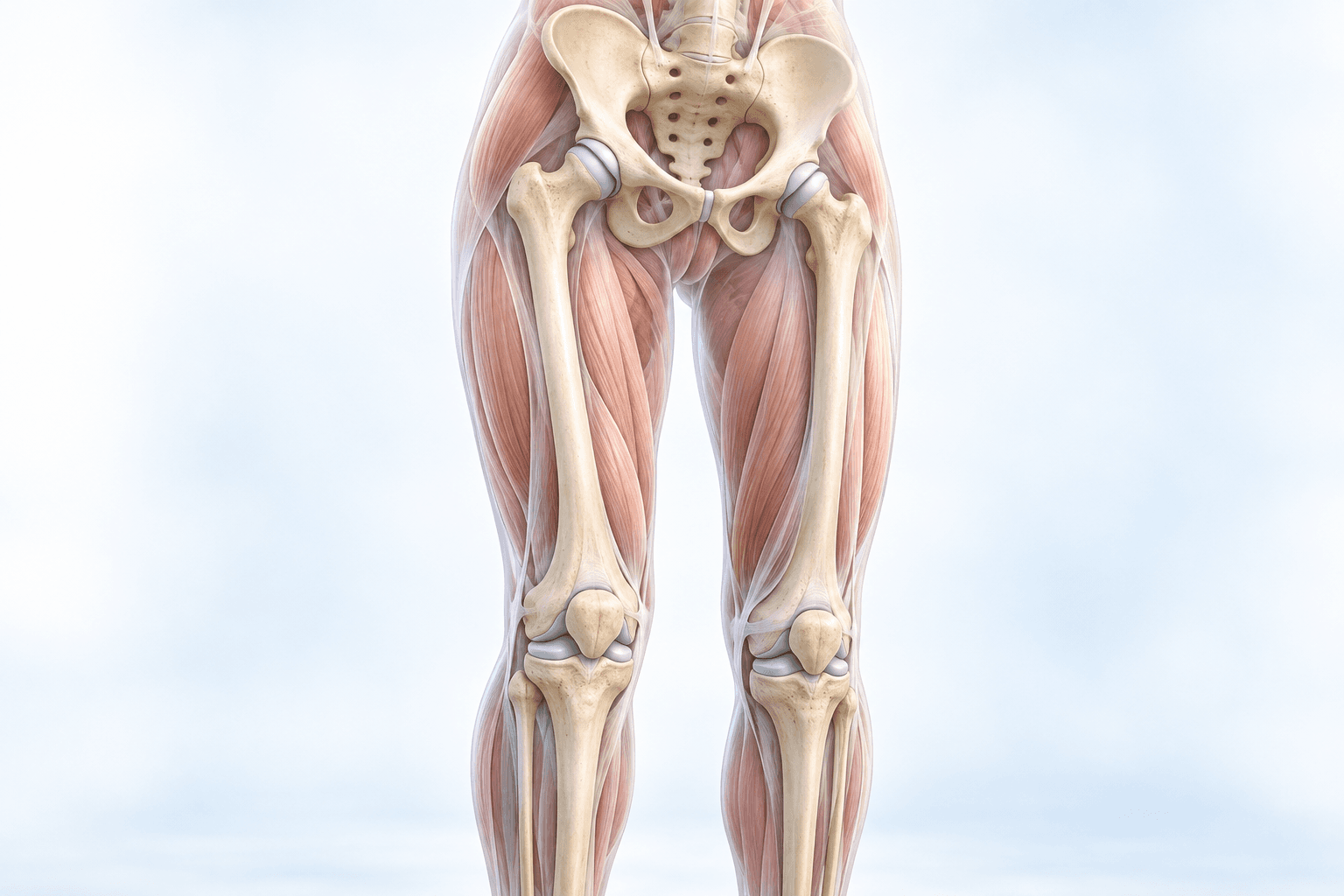
- Hip jointThe hip connects the pelvis and thigh.
- ThighMuscles cross or influence both joints.
- Knee jointThe knee links the thigh and lower leg.
Why does a physical therapist look at both?
A physical therapist may watch you walk, use stairs, squat and balance on one leg. The exam covers the knee and nearby areas, such as the low back, hip, thigh, ankle and foot.
Limited movement in the hip, foot or ankle may force the knee to work at a disadvantage, and physical therapists may work with joints from the hip down to the foot.
Where does the hip show up in knee pain?
The hip comes up in two knee conditions:
- For patellofemoral pain, exercise for the hip and thigh muscles is usually the center of a plan, and an evaluation may include testing hip and thigh strength.
- In iliotibial band syndrome, which is pain on the outside of the knee, weakness in the hip and core muscles can contribute.
Can one condition cause both hip and knee pain?
Iliotibial band syndrome is one example. It is a known cause of both hip pain and knee pain.
Do muscles around the hip play a part in hip pain too?
Weak buttock (gluteal) muscles are a contributor to pain on the outside of the hip. A Physical Therapy plan for it may include strengthening for muscle weakness or imbalance. Read more on hip bursitis.
What about arthritis in both joints?
Osteoarthritis most often affects the hands, knees, hips, neck and lower back. For osteoarthritis in general, options include:
- Exercises to improve strength, flexibility and balance.
- Weight loss, if needed, especially for the hips or knees.
- Surgery, which may be an option if other treatments do not help enough.
Physical Therapy is one treatment path for hip osteoarthritis and for knee osteoarthritis. Some people use Physical Therapy to manage knee osteoarthritis and to put off or avoid surgery.
What about hip or knee replacement?
Replacement may be recommended when pain keeps you from sleeping or from normal activities, or has not improved with other treatment. For both operations:
- A visit to a physical therapist before surgery can cover exercises and practice with crutches or a walker (for a knee replacement, a cane too).
- Moving and walking usually start early: the first day after a hip replacement, or the day of surgery for a knee replacement.
Read more on total hip replacement and total knee replacement.
What an evaluation may look at
An evaluation may include:
- Watching you walk, use stairs, squat and balance on one leg.
- An exam of the knee and nearby areas, such as the low back, hip, thigh, ankle and foot.
- A look at whether limited movement in the hip, foot or ankle puts the knee at a disadvantage.
How Physical Therapy may fit
A Shanti physical therapist begins with an evaluation. If Physical Therapy looks like a good fit, the plan is built around what the evaluation shows. Depending on the findings, a plan may use some, all or none of these approaches:
Safety note
When to seek medical care
Seek urgent medical care after a serious injury if you cannot put weight on the leg, or if the leg or joint looks deformed. Contact a medical professional for severe or worsening symptoms, fever, or concerns after an operation.
See the full safety checklist
Hip: when to get medical care first
Get emergency care right away if:
- you have had a serious fall or injury;
- your leg looks deformed, badly bruised or bleeding;
- you cannot move the hip or put weight on it; or
- worsening hip pain comes with trouble urinating or having a bowel movement.
Contact a medical professional if:
- hip pain continues after 1 week of home treatment;
- you also have a fever or rash;
- hip pain starts suddenly and you have sickle cell anemia or take steroids for a long time;
- both hips and other joints hurt; or
- you start limping or have trouble with stairs or walking.
Knee: when to get medical care first
Get emergency care right away if:
- you cannot put weight on the knee after an injury;
- your knee looks deformed;
- your calf or foot has numbness, tingling or a bluish color;
- your foot feels cool or looks blue after a knee injury. This can mean the knee has come out of joint, which is an emergency.
Contact a medical professional promptly if:
- your knee buckles, clicks or locks;
- your knee is still painful after 3 days of home treatment;
- the pain is severe;
- you have trouble bending or straightening the knee;
- you have a fever;
- your knee is red or warm;
- your knee is heavily swollen;
- your calf hurts or swells;
- an activity keeps bringing on knee pain. Get it checked before it gets worse.
If you are unsure what is causing your symptoms, ask a medical professional. Information online is not a diagnosis.
Request an appointment
Send a request and we will contact you by the next business day. Submitting a request does not confirm an appointment; your appointment is confirmed only after the clinic responds.