
Hip topic
Hip Bursitis (Outer Hip Pain)
Hip bursitis is swelling and irritation of a bursa, a fluid-filled sac that cushions the space between muscles, tendons and bones. On the outside of the hip, it is called greater trochanteric pain syndrome.
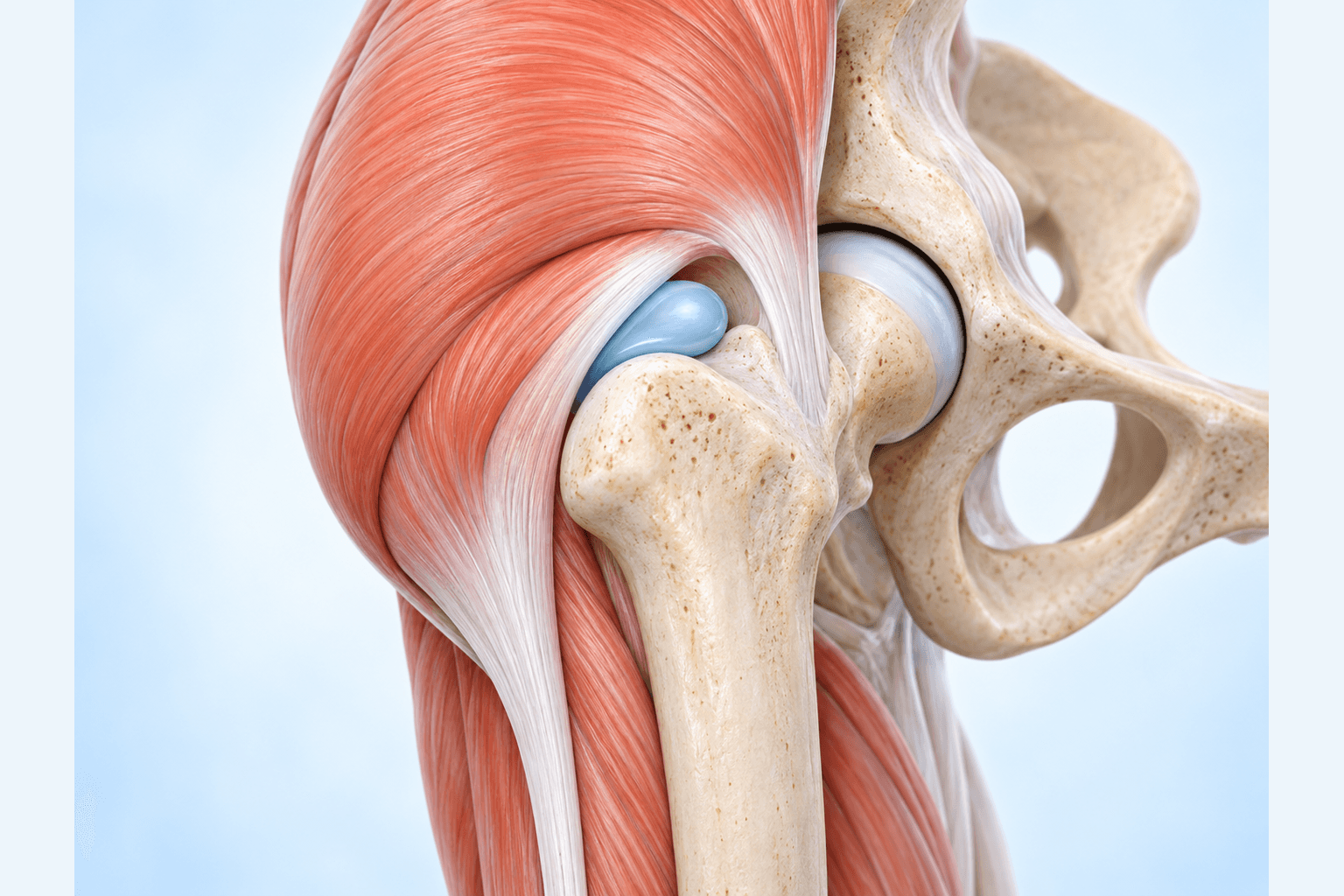
- BursaA small fluid-filled sac lies near the outer hip.
- Greater trochanterThis is the bony area at the outer upper femur.
- Outer-hip tissuesMuscles and tendons pass over this area.
What it is
The greater trochanter sits at the top of the thighbone and is the most prominent part of the hip. Greater trochanteric pain syndrome means pain on the outside of the hip.
It happens when the bursa that sits over the greater trochanter becomes irritated.
Everyday moments people describe
These are times when symptoms may be worse.
Getting out of a chair or bed
Pain is often worse as you push up to stand.
Sitting for a long time
Pain or stiffness can build when you sit for a long time.
Climbing stairs
Stairs are a common trigger.
Lying on the affected side
Lying on the sore side can make it worse.
Walking can bring it on too, with pain often worst on the first steps, and so can squatting.
How it is described
People describe:
- Pain at the side of the hip, sometimes also on the outside of the thigh.
- A sharp or intense feeling at first.
- Catching or clicking in the hip.
- Tenderness when the outside of the hip is touched.
- Limping or trouble walking, for some people.
Knowing these descriptions does not tell you what is behind your symptoms. That takes an evaluation.
What may contribute
Several things may play a part:
- Overuse or stress from exercise, or from standing for a long time.
- A sudden change in activity level.
- Injury to the hip, such as a fall.
- Being overweight.
- Unequal leg length.
- Muscle imbalance.
- Arthritis or spine problems.
- Infection, which is rare.
Repeated friction on the bursa, from a mix of muscle weakness and tightness, can add to it. Weak buttock muscles, footwear and a change in exercise routine can contribute too.
Who it is seen in
It is more common in women than in men, and is most often seen in middle-aged and older adults, including people who are moderately active.
What may happen next
Many cases ease with rest and self-care, though that is not true for everyone.
A steroid injection or, rarely, surgery are options a medical professional may discuss. Physical Therapy is one of the treatment options too.
What Physical Therapy may involve
Physical Therapy for this condition may include:
- Education to find and change outside factors that cause pain.
- Ways to manage pain.
- Strengthening for muscle weakness or imbalance.
- Range-of-motion exercise.
- Manual therapy.
- Functional training.
Exercises to build strength may be suggested as the pain eases, and Physical Therapy may be needed if you have trouble moving the joint.
What an evaluation may look at
An evaluation may include:
- Watching you walk, step onto a stair, squat or balance on one leg.
- A note on imaging: it is typically not needed to diagnose this condition.
How Physical Therapy may fit
A Shanti physical therapist begins with an evaluation. If Physical Therapy looks like a good fit, the plan is built around what the evaluation shows. Depending on the findings, a plan may use some, all or none of these approaches:
Safety note
When to seek medical care
Seek urgent medical care after a serious injury if you cannot put weight on the leg, or if the leg or joint looks deformed. Contact a medical professional for severe or worsening symptoms, fever, or concerns after an operation.
See the full safety checklist
When to get medical care first
Get emergency care right away if:
- you have had a serious fall or injury;
- your leg looks deformed, badly bruised or bleeding;
- you cannot move the hip or put weight on it;
- worsening hip pain comes with trouble urinating or having a bowel movement;
- you have difficulty standing on one leg; or
- your pain goes down your leg.
Contact a medical professional if:
- hip pain continues after 1 week of home treatment;
- you also have a fever or rash;
- hip pain starts suddenly and you have sickle cell anemia or take steroids for a long time;
- both hips and other joints hurt;
- you start limping or have trouble with stairs or walking; or
- your symptoms come back, or have not improved after 2 weeks of treatment, or are getting worse.
If you are unsure what is causing your symptoms, ask a medical professional. Information online is not a diagnosis.
Request an appointment
Send a request and we will contact you by the next business day. Submitting a request does not confirm an appointment; your appointment is confirmed only after the clinic responds.